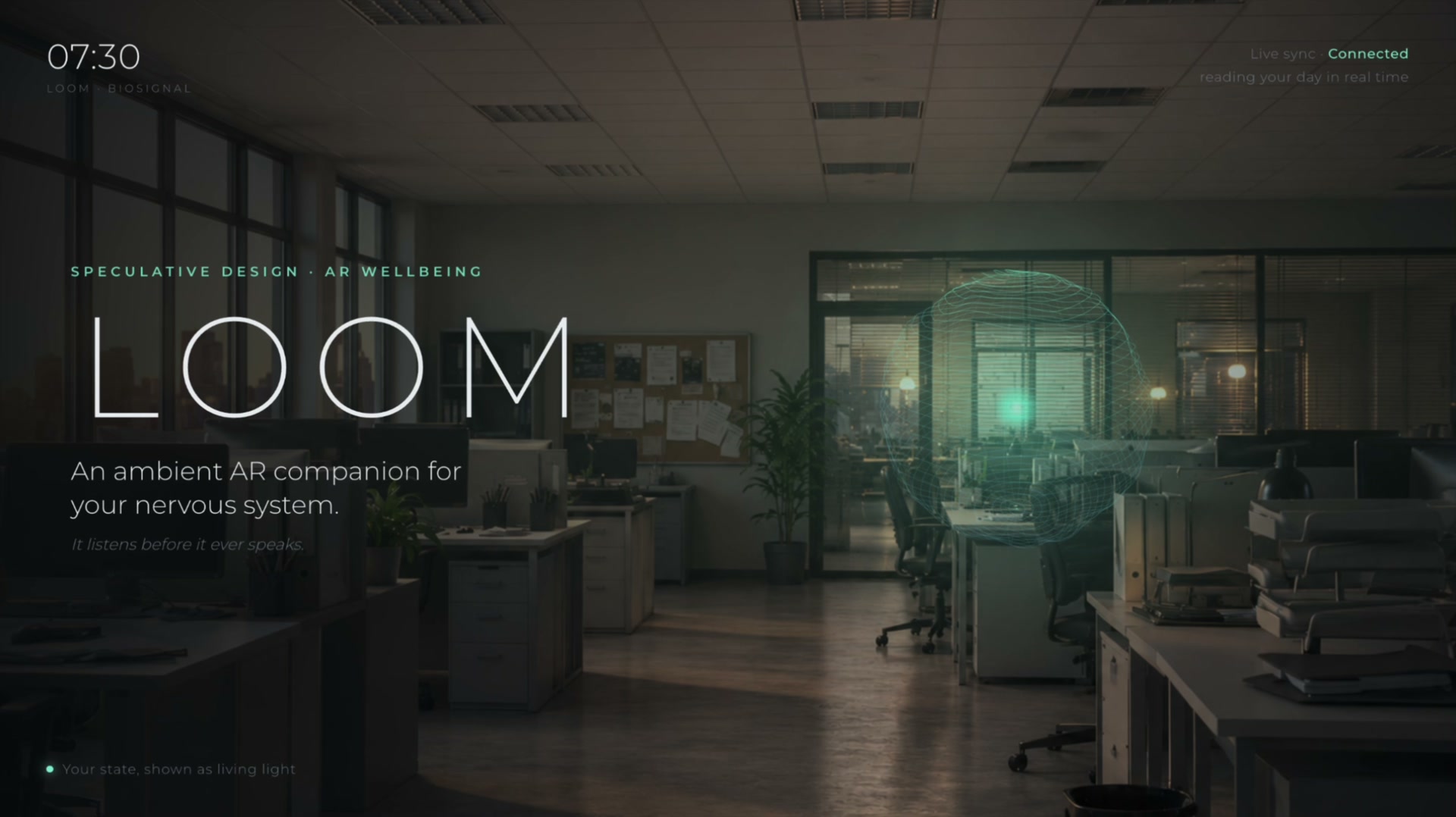
Loom is an ambient AR companion for your nervous system; it listens before it ever speaks.
A position, not a product.
Loom is a concept for AR glasses that read your body and your day (heart rate, breathing, sleep, screen light, movement, calendar load) and mirror your state back as ambient light instead of numbers. It began as a thought exercise. I was reading Anthony Dunne and Fiona Raby’s Speculative Everything with seven dashboard tabs open behind it. All of it about me; none of it for me.
So I set myself the inverse brief: what if the technology adapted to how rested, focused, or overwhelmed we are? Speculative design doesn’t ask what is possible; it asks what is preferable. Loom is one such proposal.
- Noticed · 01More measured, less embodied.Wearables tell me when I slept badly; they do not tell me how to be in the body that did. The data describes me, it does not address me. Gloria Mark and Deborah Lupton both return to that distinction.
- Noticed · 02Calm has been productised.Meditation apps frame stillness behind a paywall; streaks nudge you back into the loop they claim to interrupt. The literature on technostress is decades old (Brod, 1984; Ragu-Nathan, 2008), and the apps now selling calm have quietly become another source of it.
- Noticed · 03Wellness borrowed finance's face.The body gets rendered as a quarterly earnings report: rings to close, streaks to defend, a number that rises and falls. Health takes on the visual language of money, and you start managing yourself like a portfolio.
It proposes alternative presents, not to predict the future, but to argue for one.
No dashboard. A living thing instead.
The hero of the system is a single breathing form, not a chart, a ring, or a number. Raw streams (heart rate, breathing, sleep, screen light, movement, calendar load) distil into three lights, the only vocabulary it speaks in. Whichever light is strongest tints the whole body, so a single glance tells you what kind of day this is.
It names a state but never scores one. That is “mirror, don’t score” made literal.
On the form itself the states read as CENTERED, VITAL, OVERWROUGHT, the way they feel; in the writing I call them Calm, Vigour, Strain.
Three lights, one form.
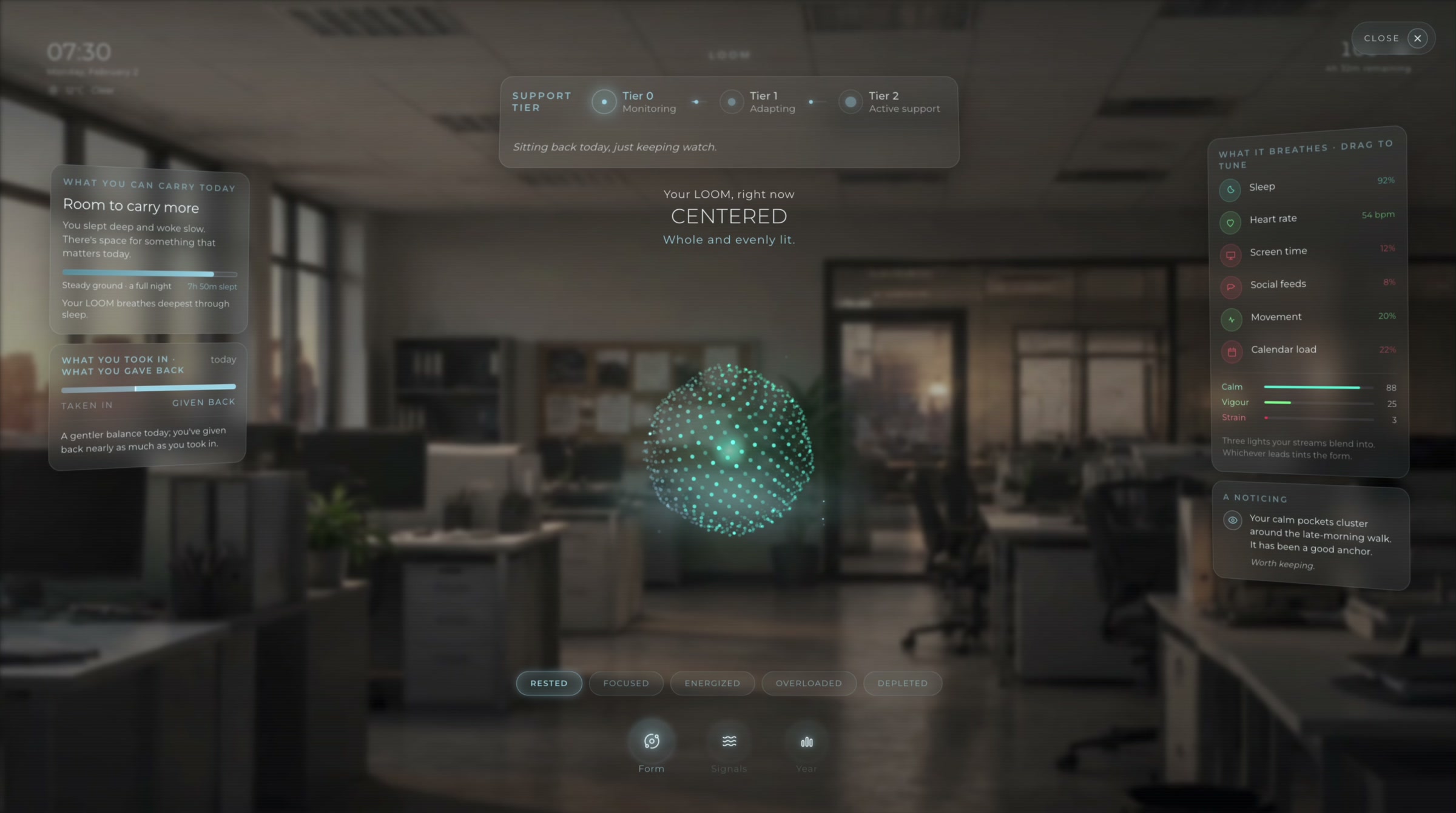 Calm
CalmCalm leads
A smooth membrane, cool teal, evenly lit.
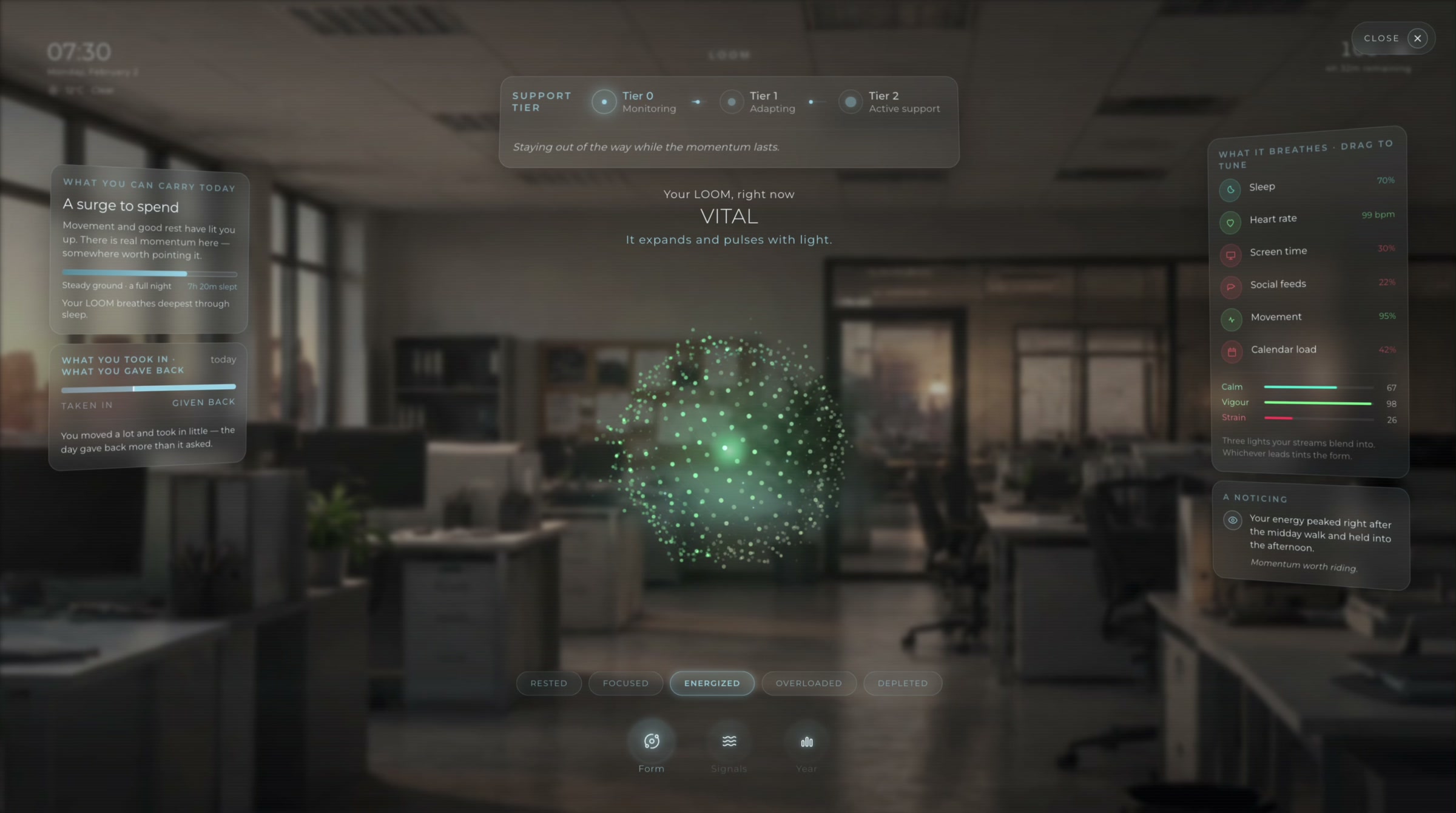 Vigour
Vigour leads
The form expands and pulses with light.
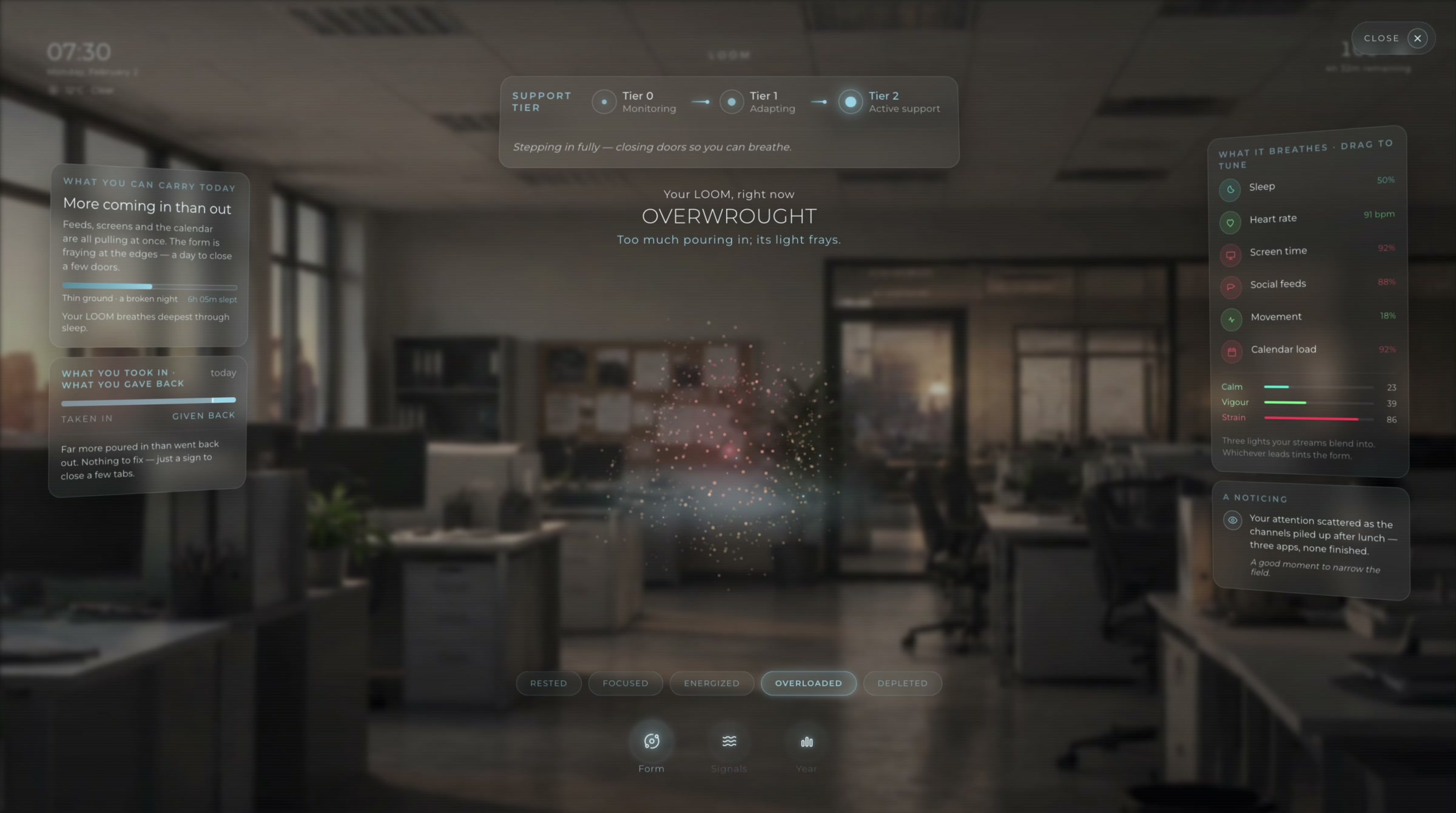 Strain
Strain leads
The day presses in; the light frays.
The data and the visual are the same object. The light is the reading.
How it grows, vertically.
The same light scales through four tiers, each quieter than the last, each mapped to a state rather than a screen. Loom grows into the body, never horizontally across tabs.
- T0 · Monitoringthe room stays the room
- T1 · Adaptationa single tint, a slower second
- T2 · Interventionone breath, your choice
- T3 · Sanctuarythe world dissolves, briefly
Four rules, in plain sight.
Peripheral first
Status at the edges, signals as washes of colour, urgency as posture rather than a number. The centre is the world; the form lives at its periphery.
Mirror, don’t score
State is light, colour, and slow motion. Never a grade, a streak, or a leaderboard. A body that becomes a number invites a verdict; light only invites attention.
Breathing motion
Nothing is still, nothing is animated to entertain. Everything drifts on a slow cycle. The form rewards relaxation, not attention.
You hold the dimmer
You set the floor and the ceiling. Every level of support is optional, and at its quietest Loom recedes to almost nothing. This is calm technology in Weiser’s sense (1996): aware of you, never interrupting you.
Hour by hour, at the edges of the day.
07:30 → 07:43 · Monitoring → Sanctuary
One thirteen-minute slice of an ordinary morning. The same form, four tiers, each escalation only with consent and each settling back on its own. The first two beats barely register; the last earns its silence.
- 07:30T0 · MonitoringInner climate · Calm
It stays quiet.
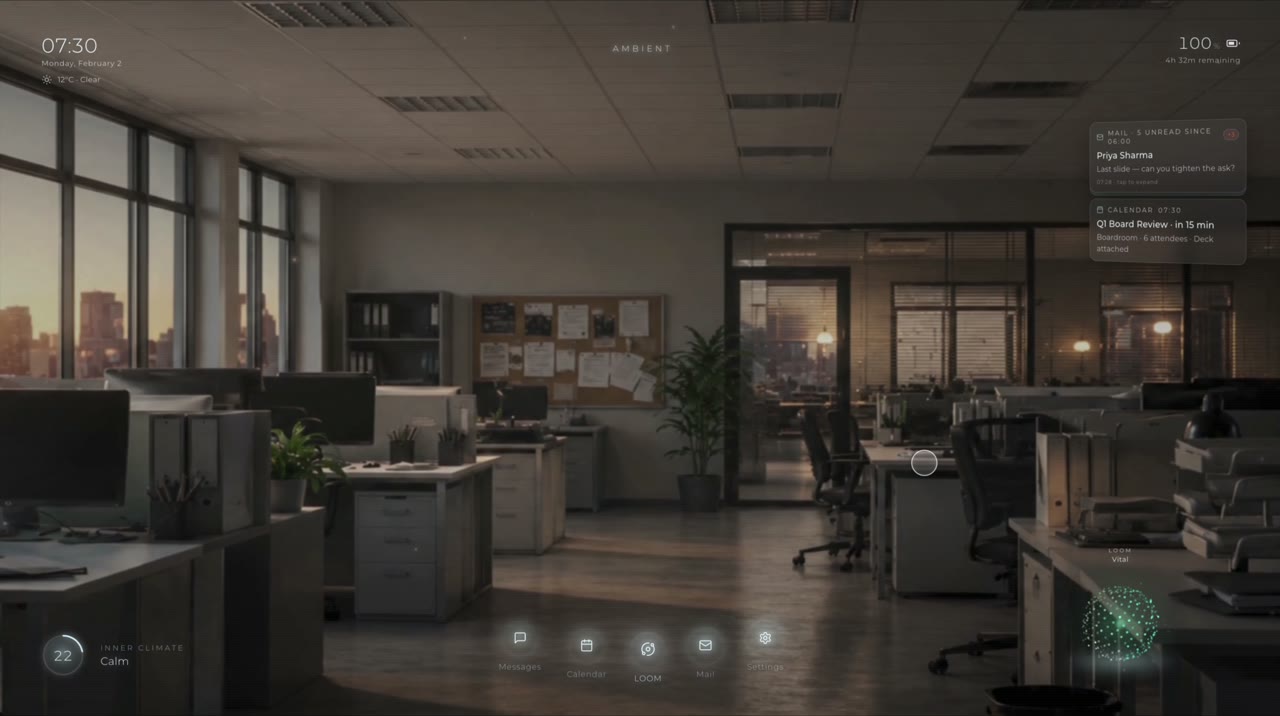
She arrives early. A thin status pill reads Ambient · 12°C · Clear. The form is barely there. Loom has been awake quietly since dawn, but it has, correctly, said nothing. On a rested day it sits here.
- 07:35T1 · AdaptationInner climate · Rising
The room tints, one quiet line.
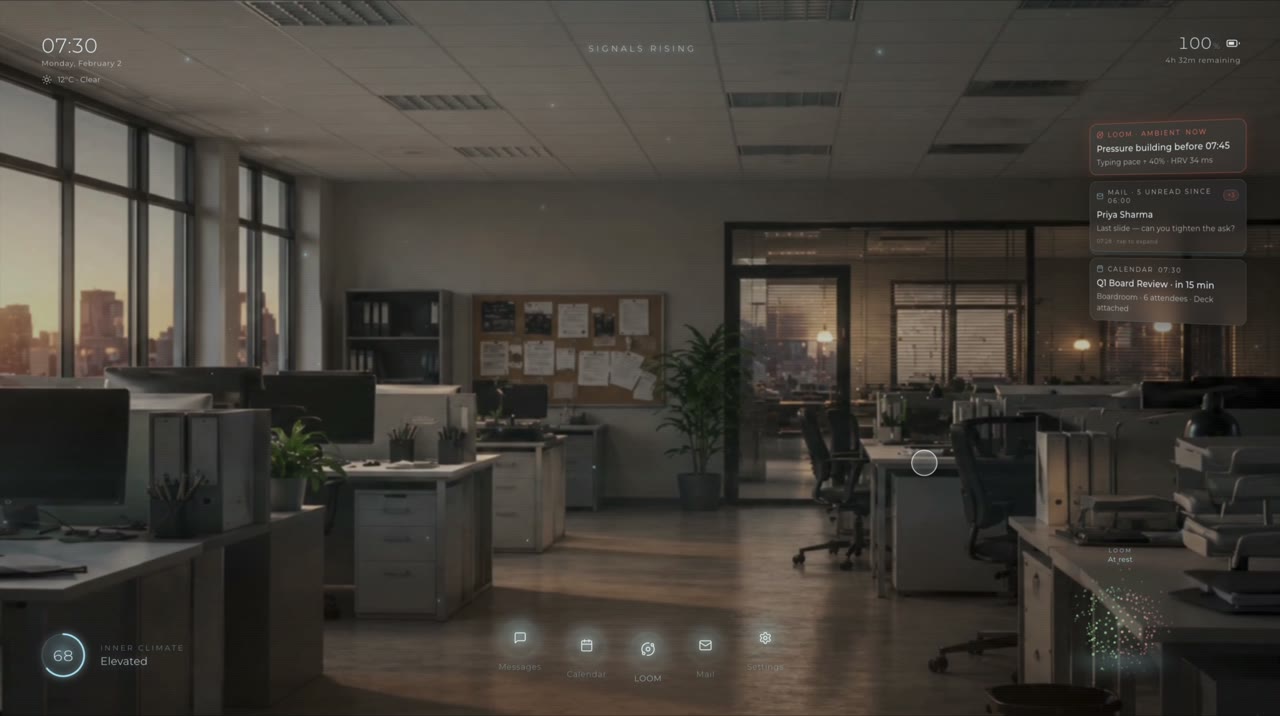
Behind the scenes, typing pace is up 40%, HRV is down to 34 ms, five mails have landed. Loom keeps it to a single quiet line at the edge, a heads-up before 07:45, the kind you can glance past. The status pill shifts from Ambient to Signals rising, and a warm wash deepens as strain climbs. The middle of the room stays clear.
- 07:38T2 · InterventionInner climate · High
An offer, never an alarm.
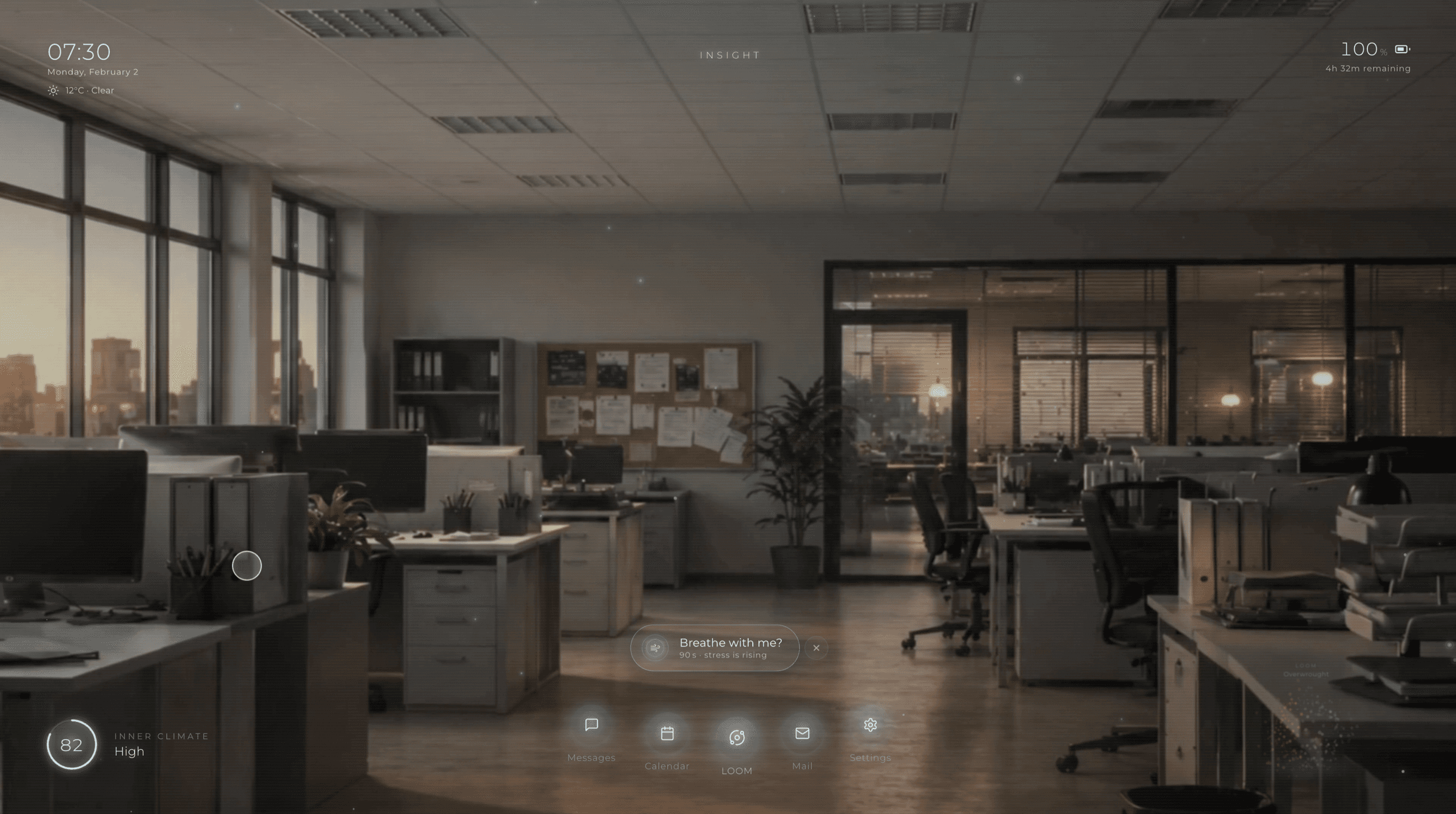
The pill becomes a single offer: a breathing ring and four words, “Breathe with me?” No alert sound, no haptic, no card to dismiss. After five seconds the ring fades back into the ambient. She can keep working or let her eye drop into it, with no consequence either way.
- 07:40T2 · InterventionInner climate · Easing
She said yes.
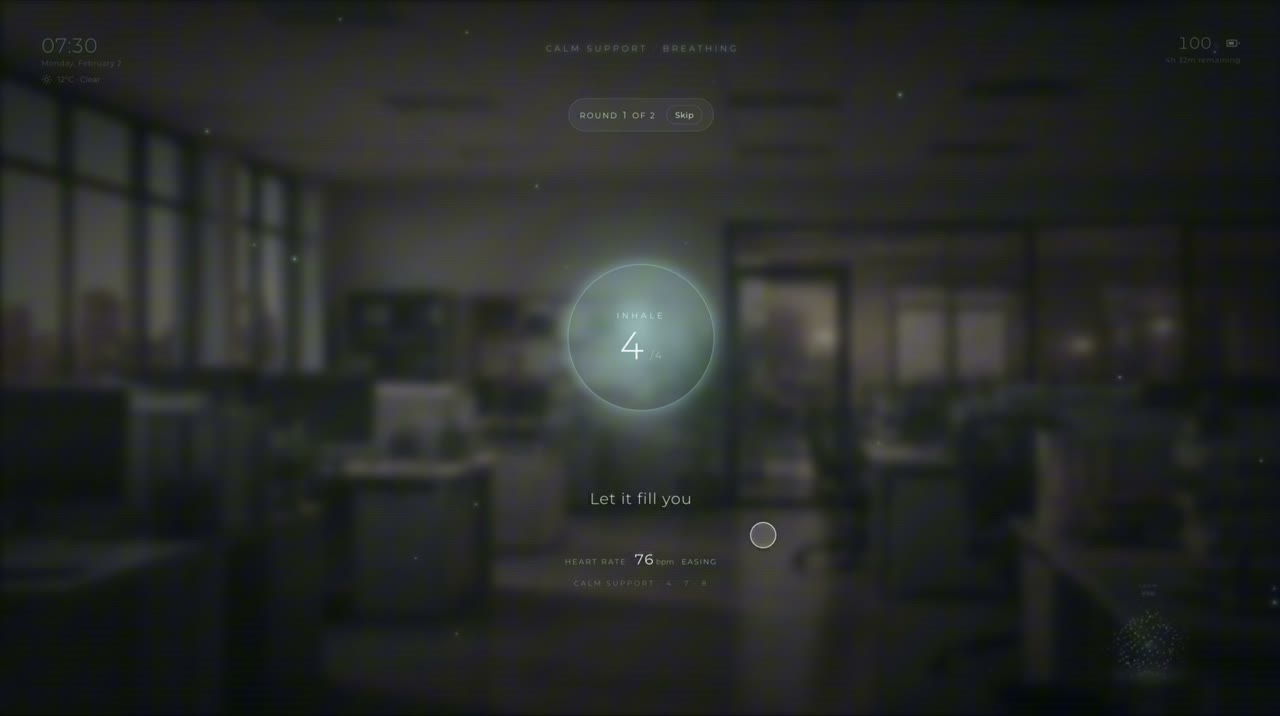
The ring collapses and expands; the inbox waits behind a soft blur. Inhale four, hold seven, exhale eight. That is roughly six breaths a minute, the rhythm heart-rate-variability research keeps returning to (Lehrer & Gevirtz, 2014). Her heart rate begins to ease alongside it. No graph waits at the end.
- 07:43T3 · SanctuaryInner climate · Calm · notifications paused
The interface earns its silence.
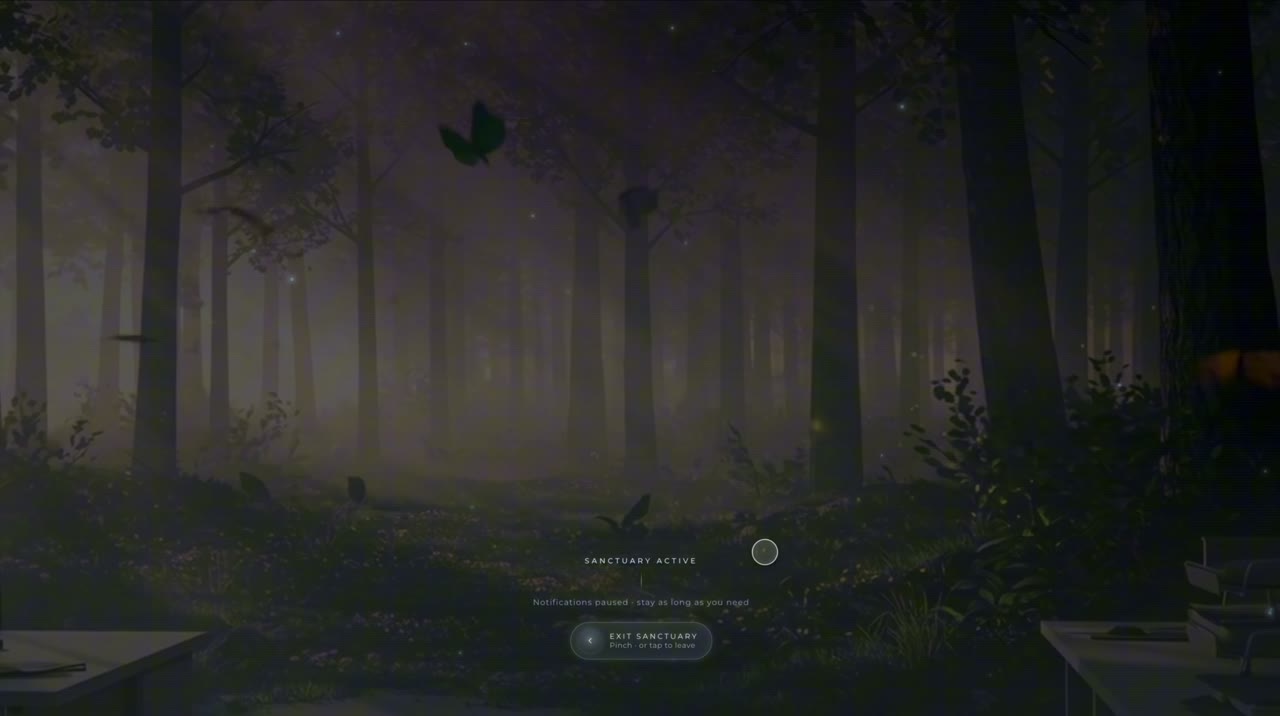
If breathing is not enough, Sanctuary opens. Over two seconds the office fades and a misty forest replaces it; side panels, nav, time and weather all go, with a soundscape that exists only here. A forest, rather than a blank void, on purpose: attention restoration theory (Kaplan & Kaplan, 1989) and the biophilia hypothesis (Wilson, 1984) both find that worn-out attention recovers in natural settings, not in absence. To return, she looks up; the office breathes back in.
The same morning, without cuts.
2:15 · With sound · Press play
The timeline above isolates the five beats; here they run together, the way they would in an ordinary morning. Seen continuously, it reads differently. The interface stays out of the way; the choices it does offer are short and easy to ignore.
Three ways to look, never a dashboard.
The body gets its own room in the OS, a spatial peer to Mail and Calendar, visited by intent. Open it from the dock and it does not become a cockpit; it offers three views of the same self, on one calm tab bar.
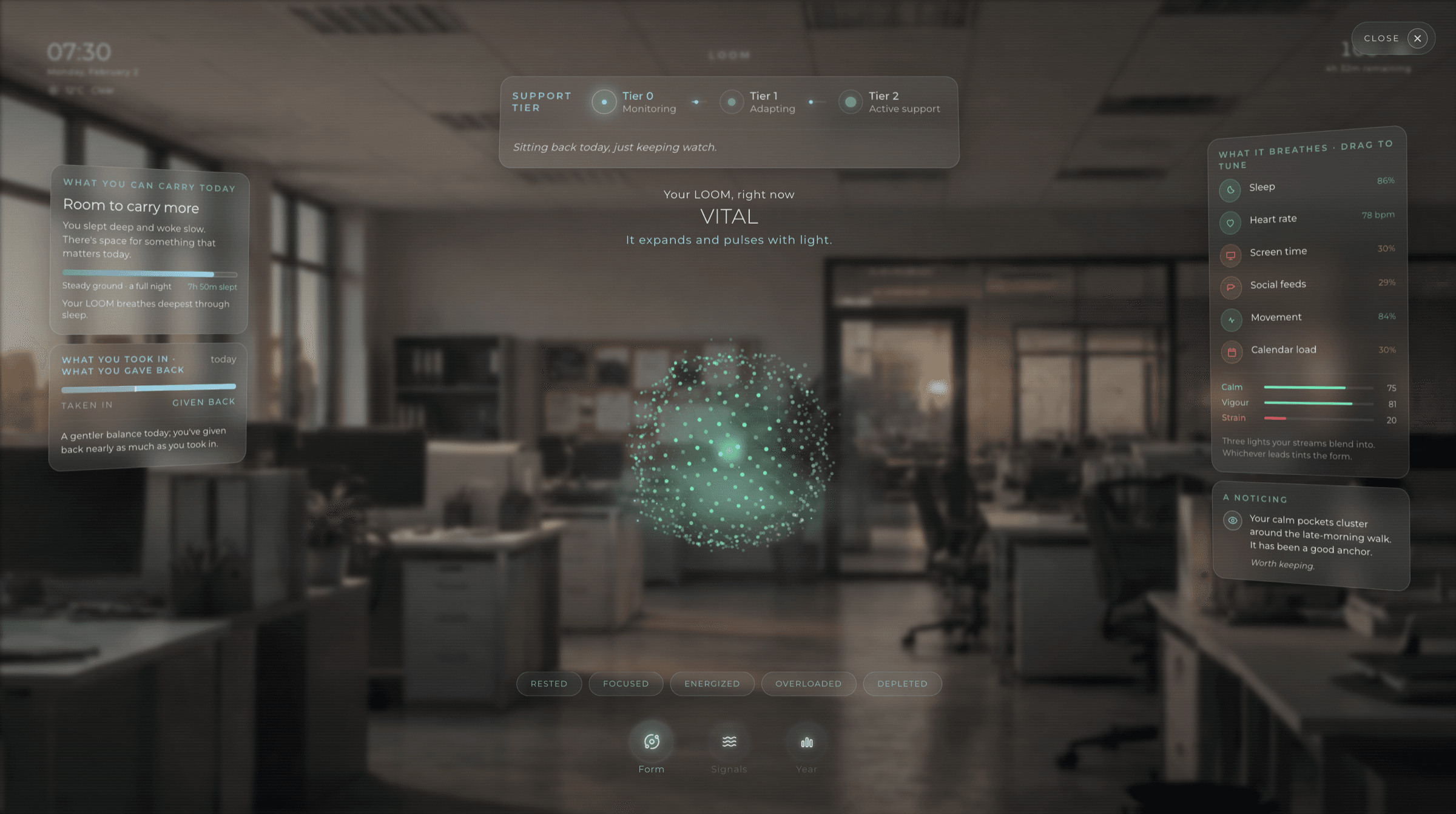
Form · the present
The present state, read four ways. No metrics; each one is the same live self, said in a different language.
- 1The living formWhole and lit, never a score.
- 2The three lightsCalm, Vigour, Strain as slim bars.
- 3What you can carryToday's headroom, in plain words.
- 4A noticingOne quiet pattern it held back for you.
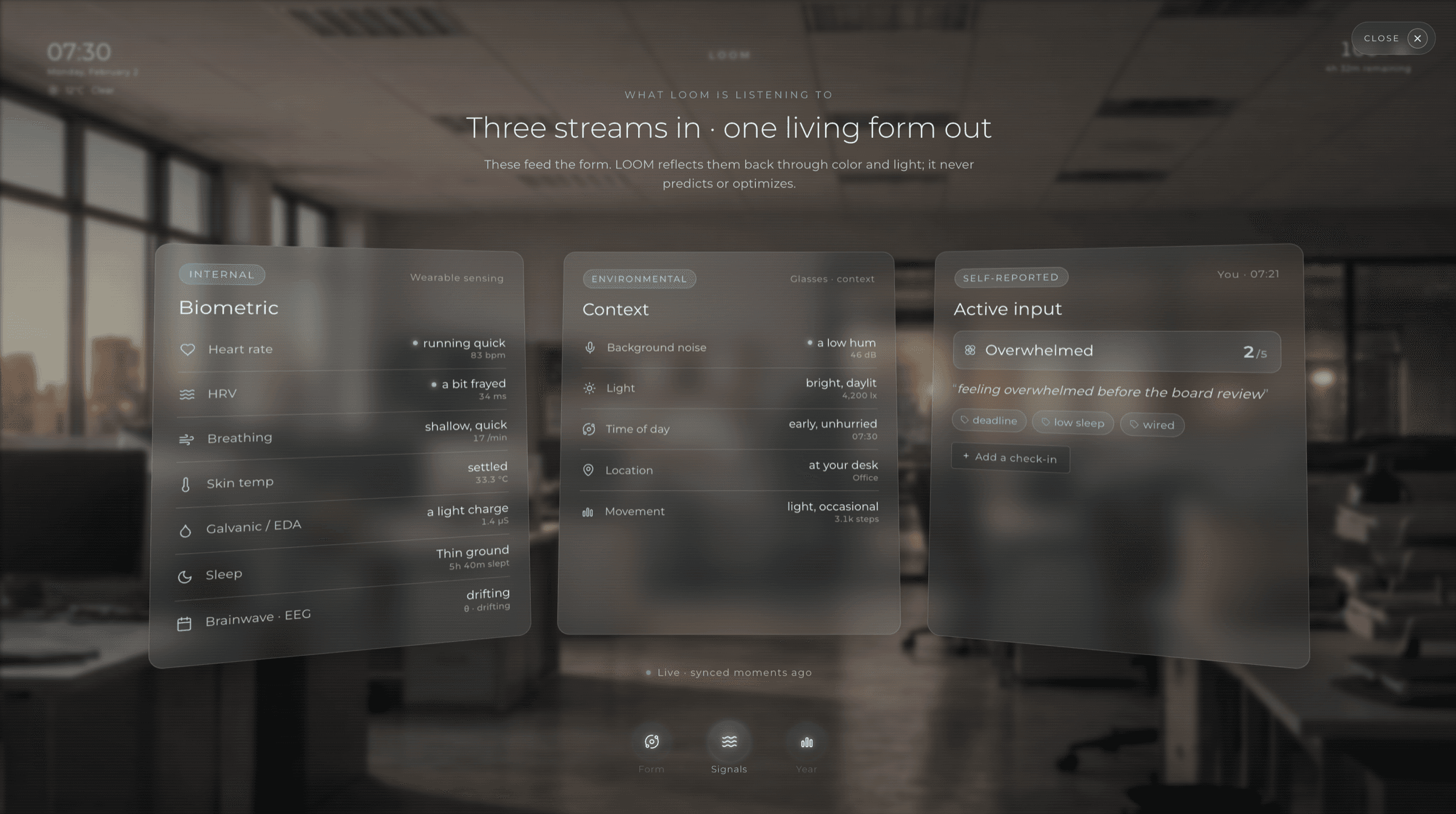
Signals · what it hears
The honest counterpart. Every input in three groups, each leading with a felt reading and keeping the raw number faint underneath.
- 1BiometricHeart rate, HRV, breathing, skin, sleep.
- 2ContextLight, time of day, location, movement.
- 3Active inputWhat you tell it, in your own words.
Drag any stream and the form morphs in real time. The system responds to the body; it does not talk over it.
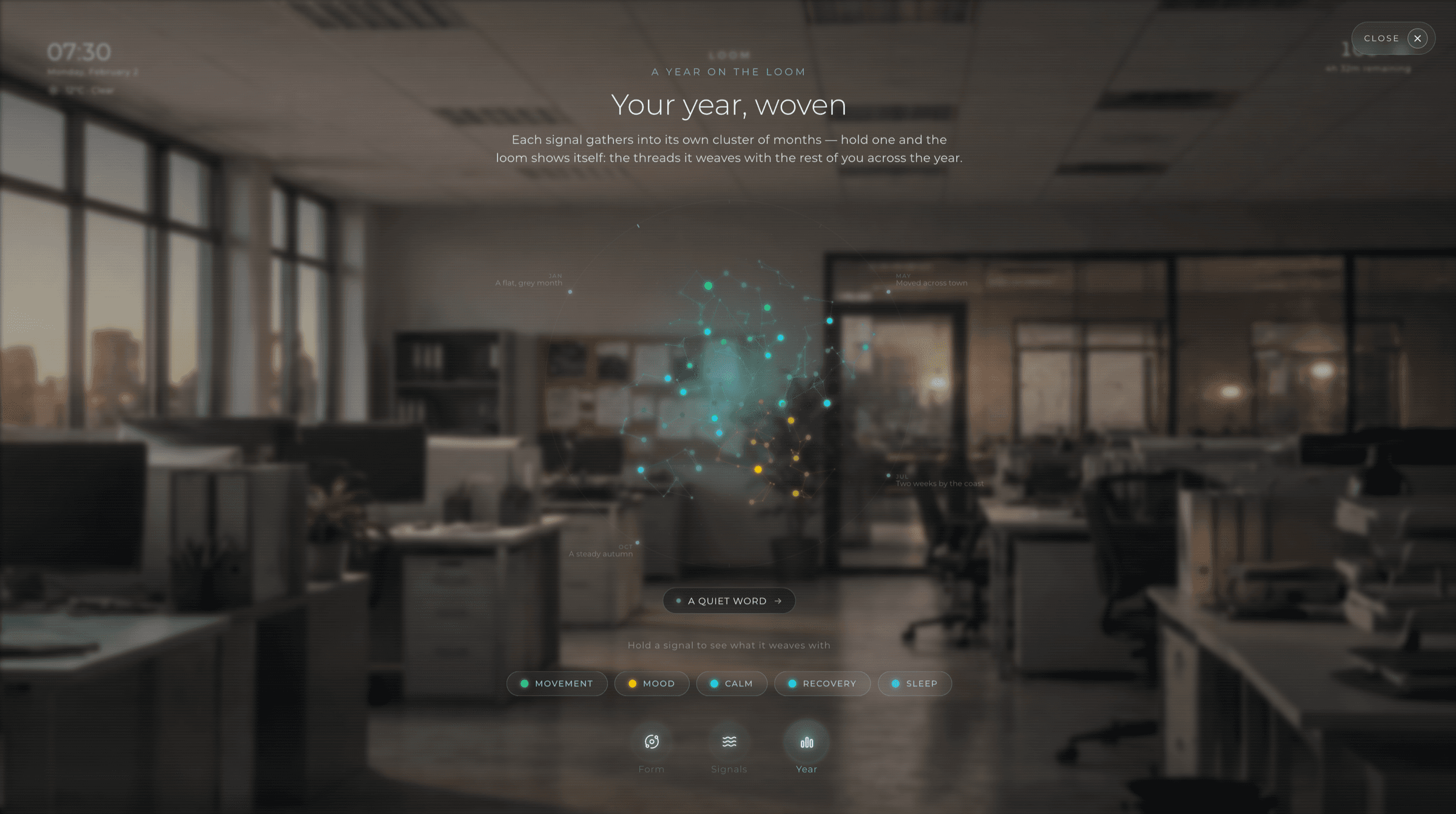
Year · woven
Not how am I now, but what has my year been.
- 1Month clustersEach signal a cluster of twelve months, in one breathing sphere.
- 2A quiet wordOne noticing, one intention. Held, never tracked.
- 3Five signalsThreads draw wherever two of them moved together.
Same language, woven in
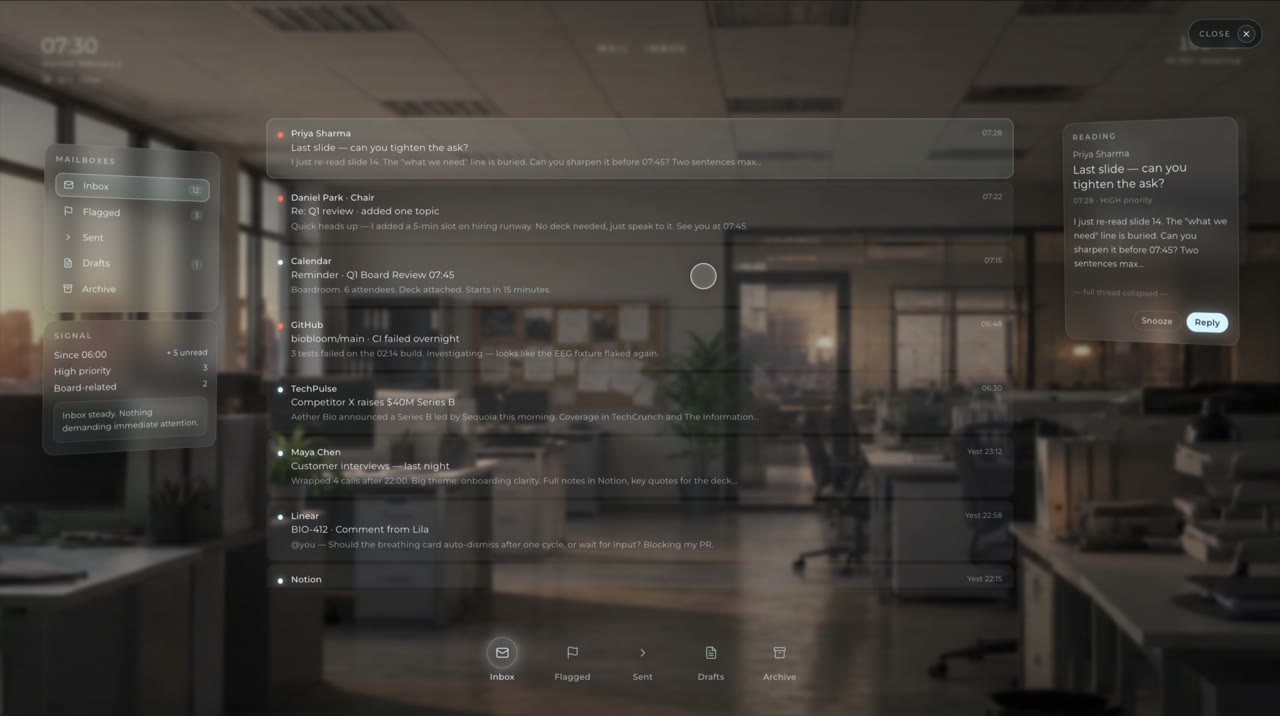
Mail
The inbox uses the same hairline and light vocabulary as the rest of the system. Read it once and the connection is unmistakable.
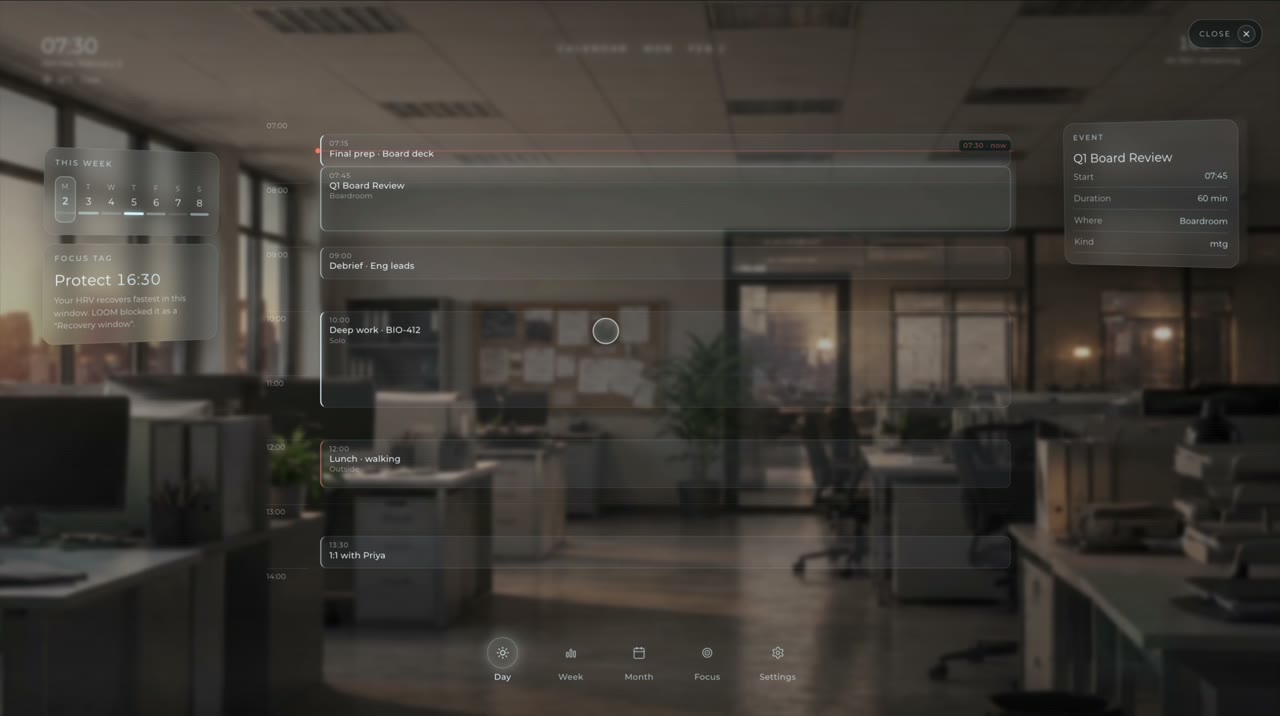
Calendar
Loom quietly defends a recovery window across the afternoon, so wellbeing isn’t something you remember to do; it sits in the calendar like any other commitment.
A position is only as honest as what it declines.
The prototype’s argument is not in a feature list; it is in the five conventions I removed. Each is so deep in the discipline that taking it out was the actual work.
01No
score.The form does not grade you. There is no number against which today is “better.” It has states, never a rank. Rank implies competition with yesterday’s self.
02No
streaks.No badges, no day-7 fanfare, no gamification of stillness. Reward Sanctuary with confetti and it stops being Sanctuary; it becomes a slot machine wearing leaves.
03No
premium tier behind calm.Sanctuary is not paywalled. There is no upsell at the moment the user is most regulated and most suggestible.
04No
data export to your employer.Biometric data is intimate, and the appropriate next step for it is mostly nothing. It is shown to the body it came from. That is the loop, end to end.
05No
face.Loom does not smile and never says “you’ve got this.” It uses the second person sparingly and never imperatively, with the affect of a librarian in a quiet wing: attentive, almost absent.
A feeling, not a feature.
The hardest part was not designing the form. It was catching my own hand reaching for the dashboard, a small streak here, a badge there, every time, and stopping it. Trusting that nothing on screen meant the system was working, and resisting the small additions that would have looked like care.
Calm is not a visual effect; you cannot blur your way to it. An interface becomes calm when you stop assuming the user needs reminding of anything, and trust the body in the room more than the data about it. That trust is structural: it shows up in spacing, in cycle length, in which state the system settles back to when you stop touching it.
What Loom offers is a feeling, the way the room slows, the way the form breathes with you instead of at you. That feeling is the part I want to carry into everything I build next.
Technology should hand you back your own state, not narrate it.